Nov 20, 2026 · 6 min read
What is a pre-sales FDE? The role quietly replacing the sales engineer
A pre-sales forward deployed engineer wins deals by building proof in the buyer's stack. What the role is, and why it's replacing the sales engineer.
Productboard just said the quiet part out loud.
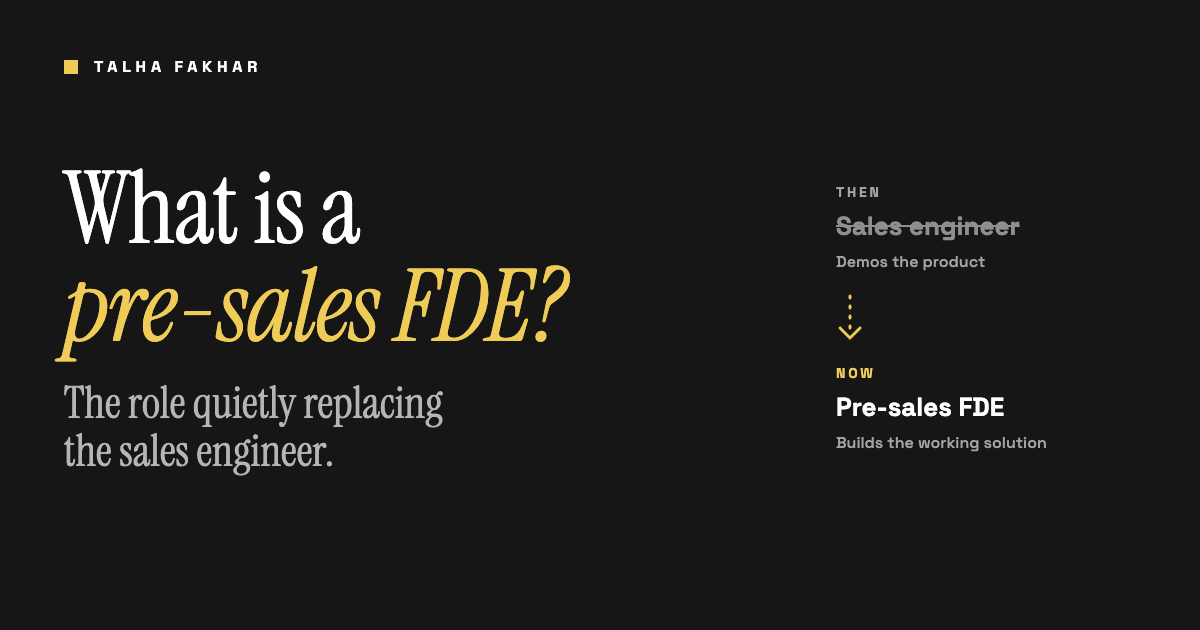
In a recent job post, it calls its Forward Deployed Engineer role the evolution of its sales engineer function. Reimagined for engineers who want to do more than demo software.
Read that again. Not a new team. Not a side project. An evolution of the sales engineer.
That is the shift. The person who used to run the demo is now expected to build the thing, inside the buyer's world, before the contract is signed.
That person is the pre-sales forward deployed engineer. If you sell a technical or AI product to US mid-market or enterprise buyers, you need to understand this role before your competitor hires one.
I have spent 9+ years in B2B GTM. I started as a freelance developer with a CS degree. Most of my best deals were won exactly this way, long before the title existed.
Here is the full breakdown.
What is a pre-sales forward deployed engineer?
A pre-sales forward deployed engineer is an engineer who wins deals by building real proof inside the prospect's environment. Their data. Their stack. Their edge cases.
A sales engineer shows what the product can do. A pre-sales FDE shows what it will do for this customer, with working code.
Tessera Labs describes its FDE Enablement role as customer-facing pre-sales work that sits where sales, product and engineering meet. The job is to frame the solution, validate it technically and build buyer confidence before the contract.
The term "forward deployed" comes from Palantir, which built its business on engineers embedded with customers. AI companies borrowed the model for delivery. Now B2B SaaS is borrowing it for the sales side.
Three things define the role:
Builds, not just demos. Ships a working prototype, integration or agent during the evaluation.
Owns the technical win. Carries the deal through security review, architecture questions and the POC.
Feeds the product. Every deal teaches the roadmap something.
Why the sales engineer is quietly being replaced
The old SE playbook was simple. Deck. Sandbox demo. RFP answers. Hand off to implementation after the signature.
That playbook breaks with AI products. Three reasons.
Buyers want proof in their own data. TSIA's research on this shift says customers now expect AI capabilities proven in real data environments during the sale. A canned demo on clean sample data proves nothing.
Products got more powerful and less finished. Insight Partners makes this point well. AI products are more capable and more incomplete at the same time. Someone has to close that gap before the buyer commits.
Pre-sales and post-sales are merging. Insight Partners also notes that at Databricks, the two now blur into one motion that starts with the customer's hardest problem.
Put those together and the demo person becomes a liability. The buyer does not want a tour. They want a working answer.
The hiring data backs it. Underdog reports FDE job postings grew more than 800% between January and September 2025. Productboard is one public example of a company folding its SE function into an FDE role.
So "quietly replacing" is accurate. The SE title is not dying overnight. It is being absorbed.
Pre-sales FDE vs sales engineer vs solutions architect
The titles overlap, so buyers and founders mix them up. The real difference is what each one ships and when.
Role | Main job | When they show up | What they ship | Measured on |
|---|---|---|---|---|
Sales engineer | Prove the product can work | Discovery to close | Demos, RFP answers, sandbox POCs | Technical win rate |
Pre-sales FDE | Prove it works for this customer | Discovery to close, often into onboarding | Working prototypes in the buyer's stack | Win rate, POC to close rate, time to value |
Solutions architect | Design the target solution | Late sales and implementation | Architecture docs, integration plans | Solution fit, deal size |
Post-sales FDE | Make it run in production | After signature | Production code, live integrations | Adoption, expansion |
Betts Recruiting draws the classic line. SEs handle pre-sales validation and hand off at close. FDEs traditionally start after the sale.
The pre-sales FDE kills that handoff. Same person, same context, from first call to first value.
What a pre-sales FDE actually does in a deal
Here is how a pre-sales FDE runs a typical enterprise deal, start to finish.
Technical discovery. Maps the buyer's stack, data, constraints and the people who can kill the deal. Less BANT, more architecture.
Scopes a sharp POC. One painful use case. Success criteria agreed in writing. Two to three weeks, not two months.
Builds in the buyer's environment. Real data, real integrations. Often an AI agent or workflow wired into tools the buyer already uses.
Handles the technical committee. Security, IT, the skeptical staff engineer. Speaks their language because they are one.
Writes the success plan. What production looks like, who owns what, and what week one after signature looks like.
Reports back to product. Every gap found in the field becomes roadmap input.
Notice what is missing. No 60 slide deck. No generic demo script. No "let me check with engineering and get back to you."
That last line alone loses deals. A pre-sales FDE answers on the call, or builds the answer by Friday.
What makes a great pre-sales FDE
The job reads like three people glued together. That is the point.
Engineer first. Reads an API doc, writes the integration and debugs it live. With AI coding tools, a strong one ships a working prototype in days.
Seller second. Runs discovery, handles objections and knows when a POC request is a buying signal or a free consulting request.
Translator always. Explains a vector database to a CFO and a renewal clause to a staff engineer. Same meeting.
Owner. Treats the deal as theirs. Nobody hands them a ticket.
The rarest trait is judgment. Knowing what not to build.
A weak FDE builds everything the buyer asks for and turns the POC into free custom work. A strong one builds the smallest thing that proves the value, then gets the signature.
This is why the role suits technical founders so well. In most early deals, the founder already is the pre-sales FDE. The real question is how long they can keep doing it while also running the company.
Who needs a pre-sales FDE (and who does not)
Not every company needs one. Here is the honest filter.
You need one if:
You sell AI, data, dev tools or integration-heavy SaaS
Deals stall at the POC or security review stage
Technical buyers go quiet after a great demo
Your ACV is high enough that one extra technical win pays for the role
The founders are still the only people who can answer the hard questions
You do not need one yet if:
Your product is self-serve and onboarding takes minutes
Deals close without any technical evaluation
You have not nailed your ICP
That last one matters most. A pre-sales FDE amplifies a motion that already works. It will not create one from scratch.
This also applies to software houses selling services. If you are a dev shop in Pakistan chasing US clients, your senior engineers are already half FDE. Put them in front of buyers. I wrote about that motion in how software houses in Pakistan can win US clients without Upwork.
The cost problem, and the fractional fix
Here is the catch. Good pre-sales FDEs are rare, and they are not cheap.
Tessera Labs lists its pre-sales FDE role at USD 135k to 213k a year. That is base pay for one person. Add equity, tooling and a three month ramp before they close anything.
For a seed or Series A startup, that is a big bet on a motion you have not proven yet. Same for a software house trying to land its first US enterprise logos.
So flip the order. Prove the motion first. Hire second.
That is exactly why we run fractional GTM at TF Business Solutions. You get a senior operator who can run technical discovery, scope the POC, build the proof with AI agents and close the technical buyer. Without the full-time hire.
Once the numbers show the motion works, you hire your first full-time pre-sales FDE with data, not hope.
If your demos impress but your deals stall, that is the signal. Book a call with TF Business Solutions and let's look at where your technical win is leaking.