Nov 16, 2026 · 7 min read
How Pakistani software houses win US clients without Upwork
Stop bidding on Upwork. A 7 step playbook for software houses in Pakistan to win direct US clients, with a 90 day plan from a B2B sales consultant.
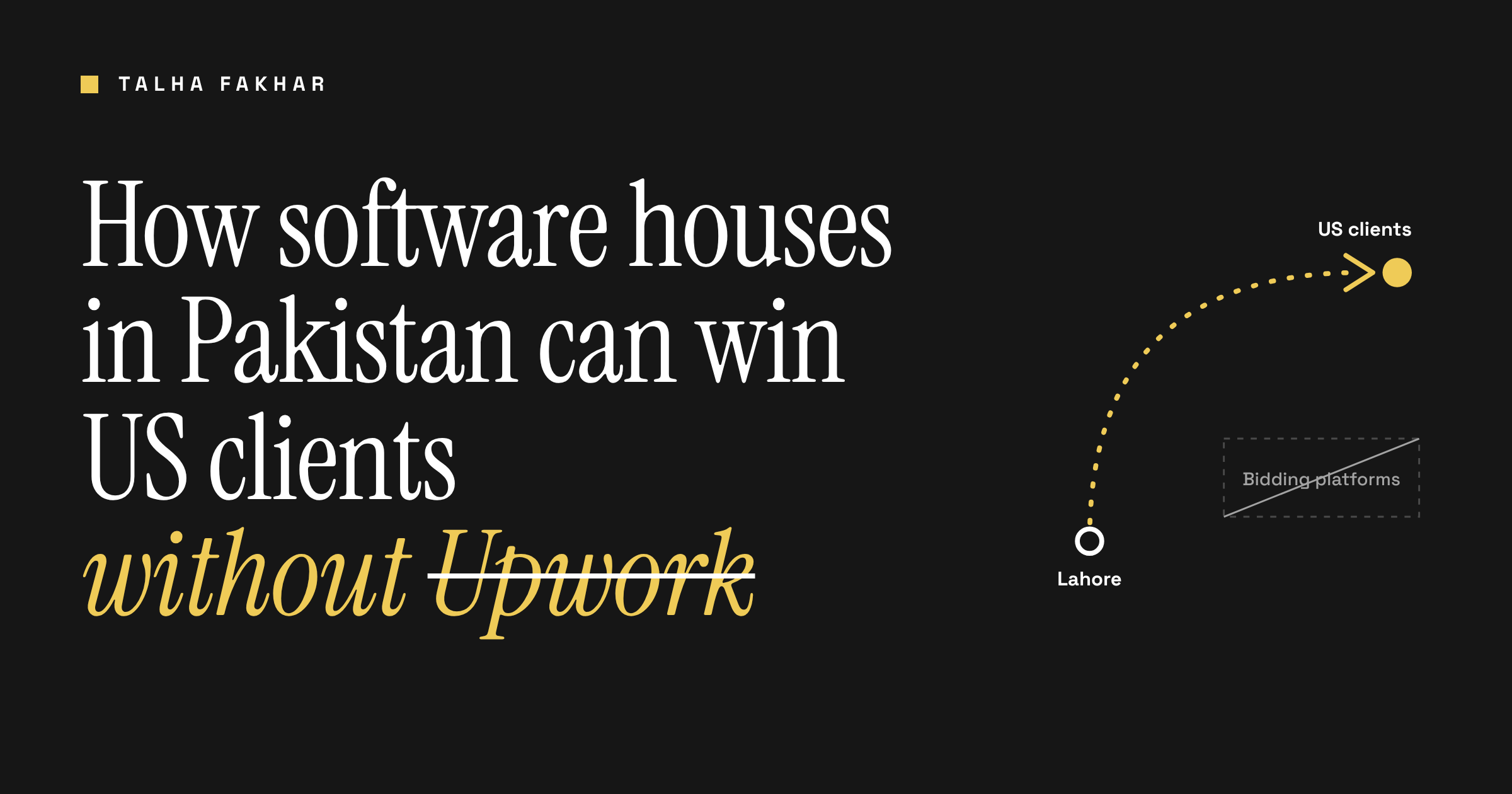
Software houses in Pakistan can win US clients without Upwork by doing four things well: picking a narrow niche, building proof a US buyer can verify, running outbound as a weekly system, and putting one senior person in charge of go to market.
The timing is good. Pakistan's IT exports hit a record $4.6 billion in FY26, up about 21% in a year, and more than 26,000 companies are now registered with PSEB (Express Tribune). The demand is real. So is the crowd. Most of those companies are chasing the same job posts on the same marketplace.
I started as a freelancer in 2017. Marketplaces fed me in the early days. They also showed me what they cost. This is the playbook I'd hand any Pakistani software house that wants direct US clients.
Why Upwork stops working for software houses
Upwork is a fine place to start. It is a bad place to stay.
You compete on price by default. The buyer sees dozens of proposals and sorts by rate.
The platform owns the relationship. One policy change or account flag and your pipeline is gone.
Deal sizes stay small. Serious US buyers with serious budgets rarely post their core project on a marketplace.
You build their brand, not yours. Your reviews don't travel with you.
The fix isn't a better profile. It's a go to market motion you own.
1. Pick a niche a US buyer can repeat in one sentence
"We do web, mobile, AI and blockchain" is not positioning. It's a menu.
US buyers don't search for a software house. They search for someone who has already solved their exact problem. So choose three things:
One industry. Healthcare, logistics, fintech, real estate. Pick where you already have work to show.
One problem. Legacy modernisation, AI agents for operations, a mobile app for field teams.
One buyer. The founder, the CTO or the head of operations. Not all three.
Here's the test. Can a client describe you to a peer in one sentence? "They build patient intake software for US dental groups" gets referred. "They're a dev shop in Lahore" doesn't.
Narrow feels risky. It's the opposite. One niche means every email, case study and post speaks to the same buyer.
2. Build proof that survives US due diligence
A US buyer will check you before the first call. Assume ten minutes of searching. What will they find?
The minimum:
Two or three case studies. Problem, what you built, result. Use real numbers and a named client where you can.
A reviews profile. Clutch or G2, with verified reviews from past clients.
Founder LinkedIn profiles that read like operators, not job seekers.
A website that speaks to one buyer and loads fast.
Clear answers on contracts, IP ownership, NDAs and payment terms.
Best work under NDA? Write the anonymised version. "A US logistics company running 200 trucks" still does the job.
3. Run outbound as a system, not a campaign
Most software houses try cold email for three weeks, get nothing and quit. The channel is rarely the problem. The list and the offer usually are.
A setup that works:
Build a tight list. 300 to 500 companies that match your niche, with the right job title at each.
Protect deliverability. Separate sending domains, warmed inboxes, low daily volume per inbox.
Lead with a problem, not your services. One specific pain, one line of proof, one soft ask. Under 100 words.
Follow up. Plan three or four touches. A single email is not a sequence.
Measure weekly. Replies, positive replies, meetings booked. Change one variable at a time.
Nobody in Ohio wakes up wanting an offshore team. They wake up with a backlog, a missed deadline or a product that won't scale. Write to that.
4. Turn the founder into the channel
US buyers buy from people. Your founder's LinkedIn is the most underused asset in the company.
Post twice a week about the niche. Teardowns, lessons from real projects, opinions a buyer would argue with.
Comment on your prospects' posts before you pitch them.
Connect with the people on your outbound list, so the email doesn't come from a stranger.
You don't need to go viral. You need 500 of the right people to see your name every week.
5. Borrow trust through partners
The fastest route into the US market is through someone already trusted there.
US agencies short on delivery capacity. White label work has thinner margins, but it teaches you US expectations fast.
Fractional CTOs and consultants who advise companies and need a team to build.
Complementary vendors. Design studios, cloud consultancies, CRM implementers.
The Pakistani diaspora in US tech. Warm introductions beat cold ones every time.
Offer a clear referral fee. Then make the partner look good. That's the whole strategy.
6. Take the offshore risk out of the deal
A US buyer isn't worried about your code. They're worried about what happens when something goes wrong.
So answer it before they ask:
At least four hours of overlap with the client's working day.
One named point of contact who communicates clearly.
A paid discovery or small pilot before any large contract.
Weekly demos, so progress is visible and not just reported.
A contract that gives the client full IP ownership.
Many software houses also set up a US entity for contracting and payments. Speak to a qualified legal and tax advisor before you do.
7. Sell like a US vendor
You can win the meeting and still lose the deal in the process.
Run discovery calls that diagnose. Ask more than you pitch.
Send the proposal within 48 hours, while the problem still hurts.
Price on milestones and outcomes, not just hourly rates.
Keep every deal in a CRM with a next step and a date.
Small things. They signal you've done this before.
The mistakes that keep software houses stuck
I see the same four over and over.
Selling hours instead of outcomes. "Senior developers at $25 an hour" invites a cheaper quote. "We cut your release cycle from six weeks to two" doesn't.
Hiding the founder. US buyers want to know who is accountable. A faceless company page won't tell them.
Copying the big players. You are not Systems Limited or 10Pearls. You can't win on scale, so win on focus.
Quitting too early. Outbound and content compound. Most teams stop a few weeks before the results show up.
None of these are talent problems. Pakistan has the engineers. What's missing is the selling.
A 90 day plan to your first direct US client
Days 1 to 30: foundation. Choose the niche. Rewrite your homepage headline. Publish two case studies. Fix the founder's LinkedIn.
Days 31 to 60: launch. Build a list of 300 accounts. Set up sending infrastructure. Start the first sequence. Post twice a week.
Days 61 to 90: convert. Run discovery calls. Pitch paid pilots. Open three partner conversations. Review the numbers and double down on what's working.
You may not close a deal in 90 days. You will know exactly what's working and what isn't. That's worth more than another year of bidding.
Who owns this inside your company?
This is where most plans die.
The founder is buried in delivery. The developers aren't sellers. A junior SDR with no strategy burns through the list in a month.
Someone senior has to own go to market: positioning, outbound, pipeline and the sales process. A full time VP of Sales in the US is expensive and hard to hire well from Lahore or Karachi.
That's why more software houses start with a fractional GTM lead. Senior, part time, there to build the system and hand it to your team.
It's the work I do with software companies through TF Business Solutions. If you want a second pair of eyes on your US go to market, let's talk.
Upwork gave a lot of us our start. It shouldn't be the ceiling.