Nov 26, 2026 · 6 min read
FDE vs solutions engineer vs sales engineer
Sales engineers prove it, solutions engineers design it, FDEs ship it. What each role does and which one your startup should hire first in 2026.
Here's a mistake founders make all the time.
They post a job for a "sales engineer." What they actually need is someone to sit inside their biggest customer's stack and ship working code.
That's not a sales engineer. That's a forward deployed engineer.
The other way round happens too. A founder hires an expensive FDE when the real gap was a sharp person who can run a demo and answer the security questionnaire.
Three titles. Three very different jobs. And in 2026, the confusion costs more than ever, because one of these roles is exploding.
This post breaks down what each role does, where it sits in your revenue motion, and which one your startup should hire first.
If you're new to the FDE idea, start with my earlier post on what a pre-sales forward deployed engineer is. This one builds on it.
What a sales engineer does
A sales engineer is the technical voice in the sales cycle.
The account executive owns the relationship and the number. The sales engineer owns the proof.
When a buyer asks "can your product actually do this?", the sales engineer answers. Usually with a live demo.
A typical week looks like this:
Running product demos tailored to each prospect
Answering technical questions on discovery calls
Filling out security questionnaires and RFPs
Setting up proof of concept trials
Handling objections an AE can't answer alone
The key thing: a sales engineer works before the deal closes. Their job ends at the signature.
They rarely write production code. They know the product deeply, not the customer's codebase.
You'll see this title most in hardware, industrial tech, telecom and classic enterprise software. The product is mostly fixed. The work is showing how it fits.
Success metric? Win rate and deal velocity. If deals with an SE attached close faster and more often, the SE is doing their job.
What a solutions engineer does
Here's the honest truth. At many SaaS companies, "solutions engineer" and "sales engineer" are the same job with a different label.
But when companies do separate them, the difference is scope.
A sales engineer proves the product works. A solutions engineer designs how it works for this specific customer.
Think architecture, not demo.
A solutions engineer will:
Map the customer's current stack and workflows
Design how your product plugs into it (APIs, data flows, SSO, integrations)
Build lightweight scripts or configs to make a POC real
Hand a clean technical plan to the implementation team after the deal closes
So they straddle the line. Mostly pre-sales, with one foot in onboarding.
This role shows up in API-first and platform companies. Think payments, data infrastructure, dev tools, cloud. Products where every customer setup looks a little different.
The skill set leans more technical than a classic SE. More cloud, more architecture, more "let me sketch this on a whiteboard."
Success metric? Deals closed that also go live cleanly. A solutions engineer who wins deals that later fail in implementation isn't winning.
What a forward deployed engineer does
A forward deployed engineer doesn't demo the product. They make it work in production, inside the customer's world.
They write real code. They sit with the customer's team. They own the outcome.
Palantir made this model famous. Its engineers were sent into client organisations to build and deploy software in the field, not from a distant office.
Then AI arrived and the model went mainstream.
Here's why. An AI agent or LLM workflow almost never works out of the box. It needs the customer's data, their edge cases, their messy internal tools. Someone has to wire all of that together and stay until it delivers.
That someone is the FDE.
The numbers tell the story. According to Lightcast data reported by Fortune, FDE job postings rose more than 1,000% from January to August 2026 versus the same period in 2025. The wider tech job market grew 13%.
OpenAI, Anthropic, Microsoft, Google and Meta are all hiring for it. The same report puts the median advertised FDE salary above $188,000.
A typical FDE week:
Scoping a vague business problem into something buildable
Writing integrations, pipelines and custom logic in the client's environment
Shipping, testing and fixing in production
Feeding what they learn back to the core product team
The big difference: an FDE works mostly after the deal. Their job starts where the sales engineer's ends.
Success metric? The customer gets measurable value, renews and expands.
And yes, there's a hybrid. The pre-sales FDE builds a working prototype before the contract is signed, so the buyer sees real results instead of slides. I covered that role in detail here.
Side by side: FDE vs solutions engineer vs sales engineer
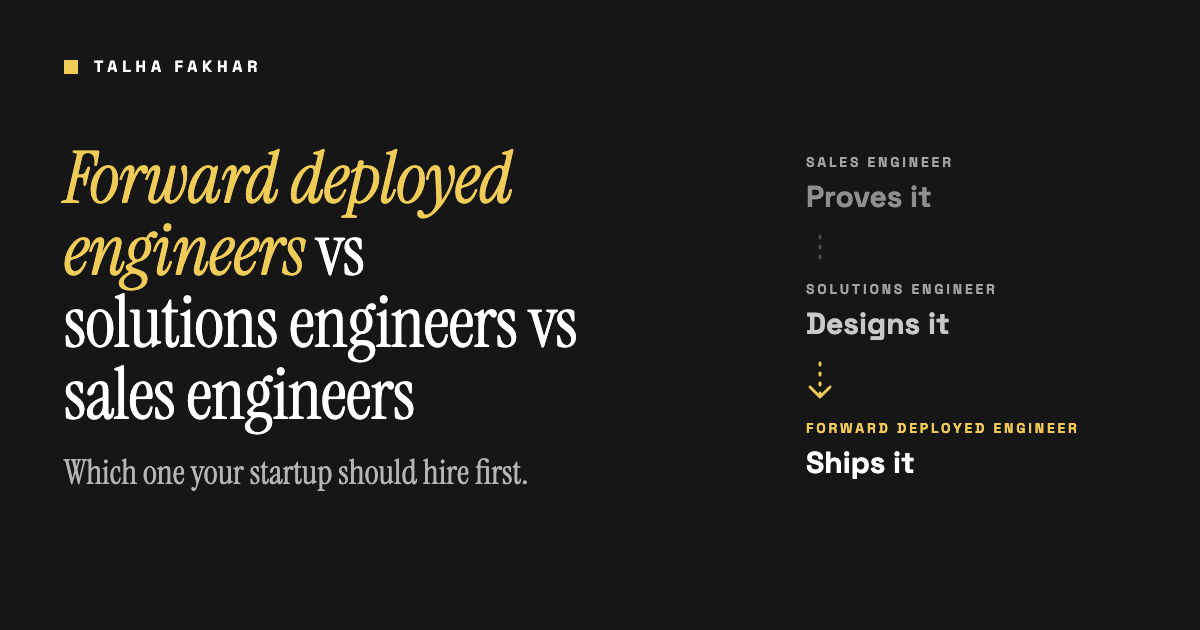
The simplest way to remember it: the sales engineer proves it, the solutions engineer designs it, the FDE ships it.
Sales engineer | Solutions engineer | Forward deployed engineer | |
|---|---|---|---|
Core job | Prove the product fits | Design how it fits this customer | Make it work in production |
When they work | Before the deal | Before the deal, into onboarding | Mostly after the deal |
Writes production code | Rarely | Sometimes (scripts, configs) | Yes, daily |
Main output | Demos, POCs, RFP answers | Solution architecture, integration plans | Live deployments, custom builds |
Reports into | Sales | Sales or presales | Engineering, product or delivery |
Measured on | Win rate, deal speed | Wins that go live cleanly | Customer value, renewal, expansion |
Best fit | Fixed products, enterprise sales | API and platform products | AI, data and complex enterprise deployments |
Which one should your startup hire first?
Don't start with the title. Start with where deals are dying.
Deals stall at "show me it works"
Prospects like the pitch but go quiet after the demo. Your AE can't handle technical questions. Security reviews drag for weeks.
You need a sales engineer.
Deals close, then implementation drags
You win the contract. Then onboarding takes three months because every customer's setup is different. Churn risk starts on day one.
You need a solutions engineer.
Customers buy, but never see real value
This is the AI startup trap. The pilot looks great. Then it hits real data, real workflows and real politics. Usage flatlines. Renewal is in danger.
You need a forward deployed engineer.
A quick guide by stage
Pre-seed to seed: the founder is the sales engineer. Don't hire one yet. Learn what buyers ask first.
Seed to Series A: if you sell AI or complex software, one FDE often beats a full SE team. They close the first big logos and turn them into case studies.
Series A and beyond: split the roles. SEs scale the pipeline. Solutions engineers smooth onboarding. FDEs handle your largest, most complex accounts.
The mistake I see most
Founders hire for the job title they've heard of, not the gap they have.
Hiring an FDE when your problem is pipeline? You'll pay a premium for someone building custom code for deals you don't have.
Hiring a sales engineer when your problem is adoption? You'll win more pilots that still don't renew.
Fix the bottleneck. Then hire the role that removes it.
Can one person cover all three?
Early on, yes. And honestly, that's often the smartest move.
At seed stage you don't need three specialists. You need one person who can run the demo, sketch the architecture and ship the first integration. Someone who speaks both sales and code.
That's the gap fractional leadership fills.
It's the work I do with founders at TF Business Solutions. We plug in as your Fractional GTM lead, figure out where deals are actually dying, and build the motion around it. Sometimes that means a sales engineer. Sometimes an FDE. Sometimes neither, yet.
If you're not sure which gap you have, book a free GTM diagnostic call. You'll leave knowing which role to hire first, and which one to skip.